Where we gather
Queer spaces & events
A scene is not a building. It is the particular hush before a drag number lands, the cloakroom queue where you meet someone you will know for the next decade, the smoking-area conversation that talks you out of a bad week. Queer space is something people make, together, in a room — and that is exactly why it is worth fighting to keep.
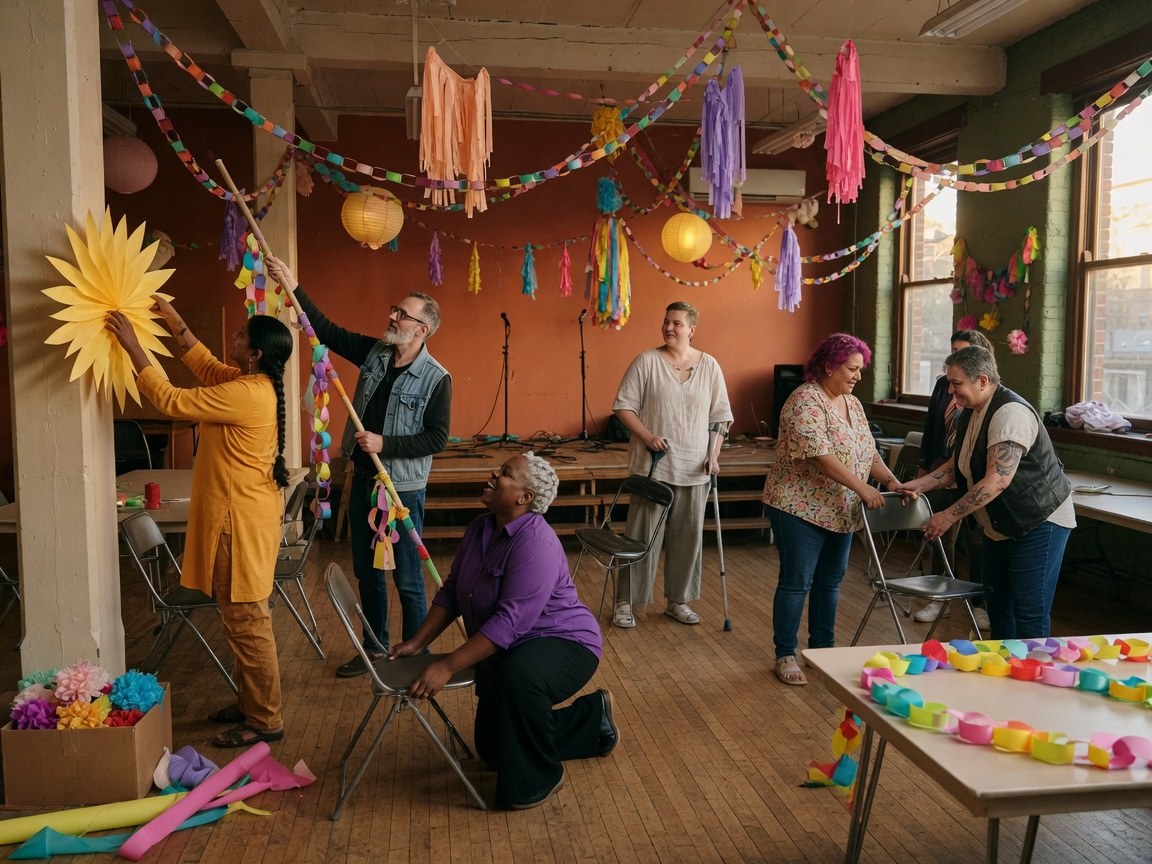
This is our hub for the physical places queer life happens: the bars and the bookshops, the community centres and the club nights, the marches and the small, unglamorous meetups in a borrowed function room above a pub. We cover why those rooms matter, why so many of them are closing, how to find ones that will actually be glad you came, and how to manage the very ordinary nerves of walking through a door for the first time. We also talk honestly about adult and lifestyle venues — because pretending grown-ups do not seek those out would be its own kind of dishonesty — and about what consent looks like once you are inside.
Why "third places" matter, and why we keep losing them
Sociologists have a tidy phrase for the venues that are neither home nor work: third places. For most people they are pleasant extras. For queer people they have often been load-bearing. When your first home is not safe to be yourself in, and your workplace expects a flattened version of you, a third place is sometimes the only room where the whole of you is allowed to exist out loud. That is not nostalgia talking. It is the simple architecture of how a lot of us learned we were not alone.
And those rooms are vanishing. Across many cities the count of dedicated LGBTQ+ venues has fallen sharply over the last couple of decades — squeezed by rising rents, redevelopment, licensing pressure, and the quiet assumption that since you can meet people on a phone now, you no longer need anywhere to actually be. Research bodies and queer cultural historians have tracked the decline rather than guessed at it; the UK's mapping work out of institutions like UCL documented a steep drop in the number of London's LGBTQ+ spaces, and similar stories repeat from one city to the next.

The loss is rarely just a loss of square footage. A venue is an institution wearing the disguise of a bar. It is where mutual-aid whip-rounds happen, where the local trans support group knows it can meet, where a nervous nineteen-year-old gets handed a leaflet and, with it, a future. Close it and you do not simply relocate the drinking — you scatter a community that used to know where to find itself.
A venue is an institution wearing the disguise of a bar.
None of which means the answer is to freeze the past in amber. New kinds of space keep appearing: sober queer mornings, daytime craft socials, neurodivergent-friendly quiet nights, pop-ups that share a room rather than carry a lease. The shape changes. The need does not.
Finding a venue that will actually be glad you came
"Inclusive" is a word every venue will happily put on a poster. The useful question is whether the room behind the poster matches it. A few honest signals tend to travel together, and you can read most of them before you ever arrive.
- Who is the night actually for? A space that names its crowd plainly — trans-led, women and non-binary, QTIBIPOC, sober, kink-aware — is telling you something true. Vagueness is not neutrality; it usually means the default crowd wins.
- Is there a written code of conduct, and is it enforced? Look for a door policy or community agreement that says what is not tolerated and what happens if it is. The presence of welfare or "safer space" staff on a busy night is a far better sign than any amount of rainbow signage.
- Accessibility is a tell. Step-free access, a clear stance on accessible toilets, content notes for intense performances, a quiet corner — venues that have thought about disabled and neurodivergent guests have usually thought about everyone.
- Who runs it, and who profits? Community-run, queer-owned, and not-for-profit spaces have skin in the game that a brand "doing Pride" for a month does not.
Find them the unglamorous way: a local LGBTQ+ centre's noticeboard, a trusted community Instagram, the back pages of a city's queer listings, or simply asking one person who already goes. National advocacy organisations such as GLAAD keep useful directories of community resources, and your nearest LGBTQ+ centre will almost always know which night is the welcoming one. If a place gives you a bad feeling at the threshold, you are allowed to turn around. Trusting that instinct is part of the skill.
First-timer nerves are normal — here is how to spend them
Almost everyone's first time walking into a queer space is a small act of courage, whatever face they wear at the bar. The fear that you will be "found out" as not queer enough, not experienced enough, not the right kind of queer, is so common it is practically a rite of passage. It is also, reliably, wrong. Most rooms are far too busy enjoying themselves to audit you.
A few things genuinely help. Go early, when it is quieter and the staff have time to be kind. Bring a friend if you can, and agree a loose plan — a check-in time, a signal that means "I want to leave." Give yourself permission to be a tourist of your own community: you can stand at the edge with a drink and just watch the temperature of a place before you swim in it. You do not owe anyone a conversation, a dance, or an explanation of your identity. And you are allowed to leave the moment it stops being fun, with no story required.
If the nerves are bigger than first-night jitters — if going out at all feels heavy, or the loneliness underneath it is the real problem — that is worth taking seriously rather than drinking past. Our mental-health hub and our support directory exist for exactly that, and there is no version of this where reaching out is the weak option.
Consent culture in adult and lifestyle spaces
Some of the spaces queer adults seek out are explicitly sexual: play parties, kink and fetish nights, clubs and lifestyle events for non-monogamous and swinging couples and singles. There is nothing shameful in any of that, and we are not going to perform otherwise. What there is, in the venues worth your time, is an unusually serious culture of consent — because rooms like these only function when everyone in them treats other people's "no" as load-bearing.
The healthy ones make the rules legible before anything starts. Expect an explicit policy: ask first, a no is final and needs no justification, watching is not the same as joining, and "dressed up" never means "available." Good venues run a door process, often a short orientation for newcomers, and staff or "dungeon monitors" whose whole job is to step in early. Phones-away and no-photos policies protect everyone's privacy. Sobriety norms exist because consent given by someone who cannot actually give it is not consent at all. If a place treats those things as optional, it is telling you what it is.
A no is final and needs no justification. In the rooms worth your time, that is not a buzzkill — it is the whole infrastructure.
Do your homework before you go. Read a venue's own rules and code of conduct in full, look for independent reviews from people in the community rather than the marketing copy, talk to the organisers with any questions, and agree boundaries and a check-in plan with whoever you are attending with. If you are couple- or partner-exploring this together, our relationships hub has gentler, slower-paced writing on opening up a relationship without bulldozing it. And if you specifically want to research couples-and-lifestyle clubs, a directory can save you a lot of guesswork — you can find swinger clubs near you and then vet anything it surfaces against everything above, because a listing is a starting point, never a substitute for your own judgement.

Spaces are a practice, not a possession
The through-line of everything here is simple: queer space survives because people keep choosing to make it and keep showing up to defend it. Spend money at the venues you want to still exist next year. Go to the small night as well as the big party. Look after the newcomer at the edge of the room the way someone once looked after you. Treat consent as the thing that lets a room be free rather than the thing that restrains it. None of that is grand. All of it is how a scene stays alive.
Below are a few directions to read on next — the wider culture these rooms belong to, how to keep yourself safe getting to and from them, the relationships that often begin inside them, and the forum where readers can swap notes.
 CultureThe scene these rooms belong toFilm, music, language and the rituals that turn a venue into a home.Read →
 Digital safetyGet there and home safelySharing your location, meeting people from apps, and protecting your privacy on a night out.Read →
 RelationshipsWhen a night becomes a personDating, chosen family and opening up a relationship without breaking it.Read →ForumAsk before you goVenue tips, first-time nerves, and what readers are actually seeing out there.Read →
This is lived-experience editorial from the Contagious Queer desk, not legal, medical or professional safety advice. Venues, laws and door policies vary by place — always follow the rules of the room you are actually in, and your own judgement first.